
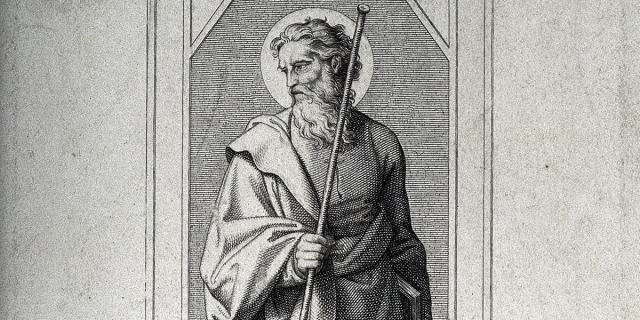
Recently SALM published online the Epistle of Barnabas in Sinhala and Tamil, which can be accessed through through the respective Sinhala and Tamil resources pages. The English can be found online here.
The Epistle of Barnabas is a Greek letter written in the late 1st or early 2nd century AD. Although the author does not identify himself or his recipients, some early Christian writers attributed it to the apostle Barnabas, which is how it got its name. Indeed, some early Christians considered the writing to be so authoritative, it appears with other writings of the New Testament in the 4th-Century Codex Sinaiticus, after Revelation and before the Shepherd of Hermas (forthcoming in Sinhala and Tamil in 2023!).
The Epistle of Barnabas is especially important because it is an early example of the way in which Christians read the Old Testament as a prophecy about Christ, in contrast with the Jewish reading of Old Testament Scripture.
Repeatedly the author emphasizes that we live in the last days, and with this eschatological emphasis, exhorts the people to act justly and do good works. Despite his heavy initial and final emphases on morality, however, he also proclaims clearly the Gospel, that Jesus Christ was crucified “so that we might be cleansed by the forgiveness of our sins” (5.1), and includes a clear “pre-anti-Pelagian” (can I call it that?) emphasis on God’s grace and the operation of the Holy Spirit through the preaching of the Word and the agency of the preacher:
“God truly dwells within us. How? The proclamation of his faith and the calling of his Gospel; the wisdom of His righteous decrees and the commandments of His teaching [didache]; he prophesies within us, he dwells within us; to us who were enslaved to death he opened the door of his Temple, which is a mouth; and granting us repentance, he leads us into the imperishable Temple. For whoever desires to be saved looks not at the man, but at the one who dwells and speaks within him.”
(16.8-9)
The author quotes many passages from the Old Testament that speak directly about Christ, to demonstrate that Jesus is the fulfillment of all prophecies about him. He also, however, applies to Christ many passages that prophecy not directly, but typologically, such as the sacrifice of Isaac, the lifting of Moses’ arms during battle, and the raising of the bronze serpent (7.3, 12.2, 12.7). Special attention is paid to demonstrating Christological typology in places where we do not usually look, such as the red heifer of Number 19 (see chapter 8).
The author also clearly expresses the sacramental understanding that baptism brings the forgiveness of sins, when it is combined with faith: “Blessed are those who put their hope in the cross and go down into the water” (11.8). Likewise he expresses an orthodox ecclesiology, by identifying believers as the location of the new Temple, “We who receive the forgiveness of our sins and put our hope in the Name become new, created again from the beginning.” (16.8)
On the other hand, the author at times includes somewhat problematic teachings. His Christological interpretation of the number 318, for example (the Greek number being TIH) seems dubious at best (9.8). Then there are times when the author’s knowledge of that natural world seems to be lacking, such as about the hare, the hyena, and the weasel (10.6-8). Finally he interprets the six days of creation to mean that the end of the world and the return of Christ would come exactly six thousand years after the creation (15.4), which cannot be established clearly from other passages of Scripture. Nevertheless he does not go so far as to give a millennialist interpretation – the seventh and eighth days seem to be merged into one – and he correctly identifies the eschatological significance of Jesus’ resurrection as the beginning of the new creation, and testifies to the reason why Christians worship on Sunday (the eighth day, 15.9).
Finally like many other early Christian texts, this epistle also gives us interesting insights into the expectations of holy living for Christians (e.g. against abortion and infanticide in 19.5, 20).
Although this epistle demonstrates by some specific and accidental errors that it is not infallible (and therefore rightly not to be considered canonical Scripture), nevertheless it also demonstrates an approval and exemplary wider use of the typological method of interpretation that is employed in other books of the New Testament.